specialty drinks and your teeth

We hope you all had a enjoyable festive season meeting up with family and friends to share memories and make new ones.  With the many social occasions, we always have different beverages available. From fizzy kombucha and sparkling water to the intense jolt of energy drinks, specialty beverages have become staples in our routines. While they can offer unique benefits like gut health or hydration, many come with oral health considerations.

Learn how to enjoy your favorite drinks without compromising your smile!

1. Energy Drinks: A Jolt or Jinx for Your Teeth?

  • Energy drinks are famous for their quick energy boost, but their effects on teeth are less thrilling.
  • Acidic Punch: With pH levels around 3 or lower, energy drinks can weaken enamel.
  • Sugar Spike: The sugar fuels bacteria that cause cavities.
  • Tip: Use water as a chaser to reduce acidity and sugar impact after sipping.

2. Kombucha: The Gut-to-Mouth Connection

  • Kombucha is a favorite for its probiotics, but the acidic nature of this drink can impact your teeth.
  • Enamel Erosion: Its pH level can contribute to enamel loss.
  • Hidden Sugars: Even health-conscious brands may include added sugars.
  • Pro Tip: Use a straw and wait 30 minutes before brushing after drinking kombucha.

3. Sparkling Water: A Bubbly Debate

  • Sparkling water is a refreshing, low-calorie alternative to sugary sodas, but how safe is it for your teeth?
  • Mild Acidity: The carbonation creates carbonic acid, which is less harmful than energy drinks or soda but still slightly erosive.
  • Plain vs Flavored: Flavored varieties often contain citric acid, increasing acidity and enamel risk.
  • Sip Smart: Stick to plain sparkling water and pair it with meals to neutralize acid naturally.

4. Healthy Sips: Balancing Enjoyment and Oral Care

  • Enjoying specialty drinks responsibly is key to keeping your smile healthy:
  • Choose Wisely: Opt for unsweetened or low-sugar options when possible.
  • Drink – don’t sip: Having small sips over a long time will do more damage than drinking it all down.
  • Rinse with Water: After drinking, rinse with plain water to reduce acidity and sugar residue.
  • Regular Checkups: Stay ahead of potential issues with routine dental visits.

If you love sparkling water? Wonder how to enjoy it safely? Or maybe you’re curious about another drink? Ask your dentist or hygienist at your next appointment.

See you in the clinic!  The Victoria Park Dental Care team.

PS:  check out our socials (Facebook, LinkedIn, Instagram) for top tips for teeth, mouth and gums and dental family snaps!  Maybe even the latest video on YouTube. 
Team Electric or Team manual

14th October 2024 is World Cavity Free Day! The focus is on children with healthy eating, healthy brushing habits and drinking water.  The research shows that children copy their parents, and modelling great brushing habits will assist your children and grandchildren to save their teeth from cavities.  So, families that brush together not only keep their teeth clean and cavity free, but also save on the costs of tooth decay in the long term!

With tooth brushing we have the option of electric or manual methods.  We thought we would share some of the hints and tips around electric and manual toothbrushes.  What do you use at home?  Patients report to us a mixed use of electric and manual brushes, sometimes using a manual in the morning and electric at night.  Even amongst our team, there are “team manual” and “team electric”.  Personal preference plays a large part in selection.

Electric toothbrushes are highly researched and developed to produce a quality, efficient, reliable product.  Research has shown that electric toothbrushes are very effective at cleaning of teeth.  The toothbrush uses an oscillating motion, with a small circular brush head.  This is ideal for manoeuvring around tight spaces and reaching back teeth.  Most electric toothbrushes are rechargeable and fully waterproof, so no need for concern in wet areas like the bathroom.  When you are purchasing an electric toothbrush make sure you have one with the pressure sensor so you can’t push too hard.  With the Oral B electric toothbrush, the whole family can use the one brush, and the colour-coded rings make it easy to identify whose brush head is whose.  Being gentle and letting the toothbrush do the work is most important with the electric toothbrush – don’t brush with it!  Hold the brush gently on the teeth and let it do the work for you.

Manual toothbrushes have been around since 619, and were first found in China and made of hogs’ bristles.  Thankfully the modern toothbrush is a small, soft and carefully made product.  Look for a manual brush with soft or extra soft bristles to minimise damage and a small head for reaching back teeth.  The simple looking toothbrushes are gentler on the teeth and gums.  Use a gentle, circular motion to move around your mouth, spending time reaching all surfaces of the teeth towards the cheeks and towards the tongue.  Our team is happy to show you how to refine your brushing technique.  We have both plastic and bamboo manual toothbrushes available here. Don’t forget you can recycle all toothbrushes, packaging and electric brush heads at the practice.  Please bring them in with you anytime so we can recycle our plastic waste.

Dental benefits – Please remember, as we head towards the end of the year and, dare we say Christmas, we do book up very quickly.  For bookings in the next few months, start scheduling now.  Don’t forget your dental benefits limits for this year finish on 31st December for most funds.  Make the most of those benefits.

Clinic news – Welcome to Soheila as she joins our hygiene team. She will be working on both Tuesday and Wednesday.

See you in the clinic!  The Victoria Park Dental Care team.

PS:  check out our socials (Facebook, LinkedIn, Instagram) for top tips for teeth, mouth and gums and dental family snaps!  Maybe even the latest video on YouTube. 
Your questions answered on tooth whitening

We have had a number of people ask us about whitening their teeth and the options for a brighter smile.  Whitening is a possibility and depending on your tooth enamel, numbers of fillings present and your gum health it is an option for most people.

Teeth whitening is an easy way to brighten and freshen your smile.  There are a number of products on the market for whitening teeth.

Whitening toothpastes and whitening strips will remove and help prevent the build up of external stain on the enamel.  For example, they will reduce the coffee and tea marks on your teeth.  They don’t have the strength to change the actual colour of the enamel.  Some of them can be a bit abrasive so stick with the renown brands or ask your dentist or hygienist when you see them next.  

Whitening gels from your dentist will change the colour of the enamel.  We prefer the “Zoom” whitening product for ease of use, gentleness to patients and successful whitening outcomes. 

  • We take impressions of your teeth, our laboratory makes trays which fit exactly to your teeth, and then you simply add the whitening gel. 
  • The whitening gel stays on your teeth for 45 minutes per day or overnight for approximately 7 – 14 days depending on the depth of colour change and is applied in the comfort of your home. 
  • Most of our patients prefer not to bleach their teeth “too white” and this is another advantage of the take home whitening, as you can choose when to stop.

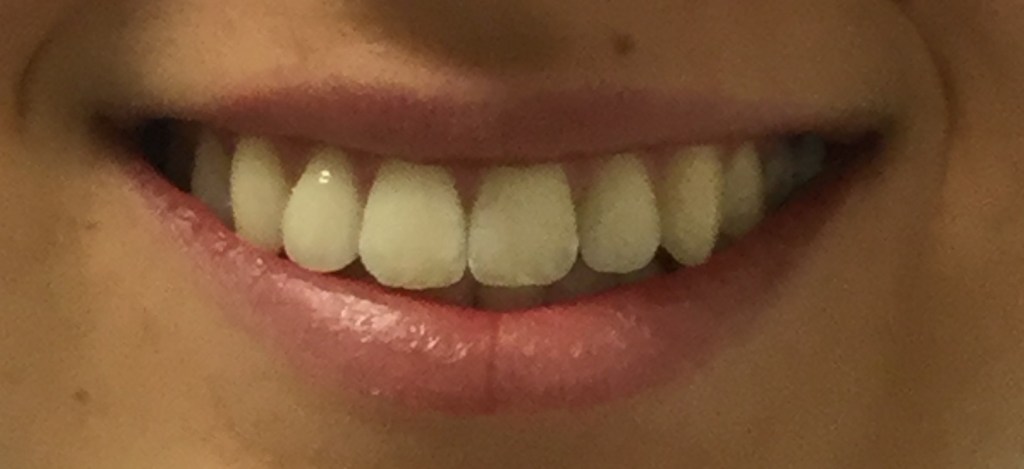
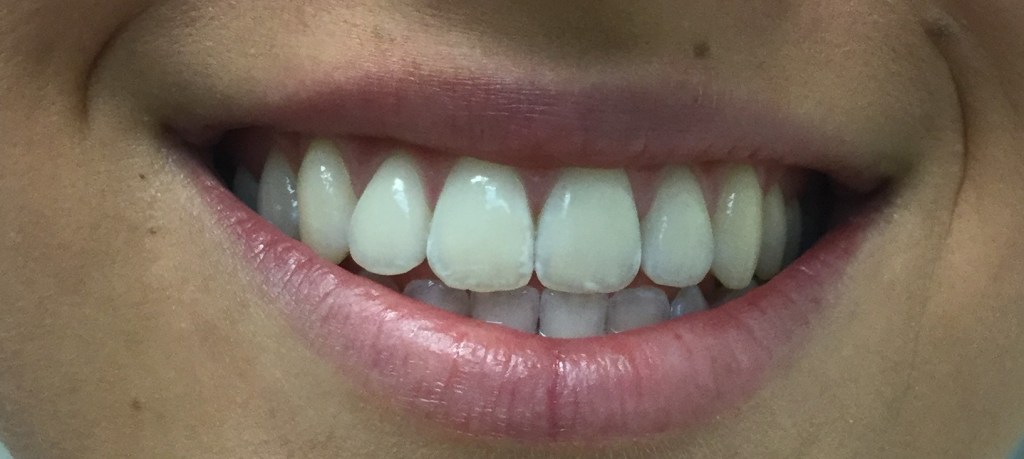
Images of whitening our patient’s teeth. (Yes, she has lovely teeth!)

In-Office whitening from your dentist or hygienist is another option.  We find this option is less gentle on the teeth and your teeth can be very sensitive for quite some time.  It is also a long appointment with your mouth open.

Tooth sensitivity is often a side effect of whitening your teeth, especially if you have exposed root surfaces.  We can mostly manage this with desensitizing agents, such as Tooth Mousse and care during eating and drinking.

Try not to purchase whitening toothpastes or gels over the internet.  Often, they haven’t been approved by the Australian Therapeutic Goods Administration, which signs off on the safety and effectiveness of any product.

Dental benefits – Please remember, as we head towards the end of the year and, dare we say Christmas, we do book up very quickly.  For bookings in the next few months, start scheduling now.  Don’t forget your dental benefits limits for this year finish on 31st December for most funds.  Make the most of those benefits.

Clinic news – Welcome to Insuk as she joins our hygiene team. Zakia will be working with Dr Stone on Tuesdays and Insuk with Dr Nguyen on Wednesdays.

See you in the clinic!  The Victoria Park Dental Care team.

PS:  check out our socials (Facebook, LinkedIn, Instagram) for top tips for teeth, mouth and gums and dental family snaps!  Maybe even the latest video on YouTube. 

#letstalkaboutgums – dental Health week

Dental Health Week is here again!  The theme this year is #letstalkaboutgums.

So, lets talk about gums!  Your gums should be firm, stippled, pink for Caucasian/Asian heritage, brown/pink for African heritage and should come to a point between your teeth.  You should be able to floss between the front side and rear side of the gum point (papilla) and your tooth easily.  You should have no bleeding when you do this and the pocket you are flossing will be about 3 – 4mm deep.  The gum height between your teeth is related to the bone height.  The gum height is usually 2 -3mm higher than the bone height.

When your gums are unhealthy and inflamed, they will bleed, they might have pus and they will look red and swollen with no stippling.  There is, of course, a range between gingivitis (gum inflammation) to periodontitis (gum disease).  Gingivitis is relatively easy to treat.  We need to remove the hard plaque under the gums with a good, thorough cleaning of your teeth and with good flossing and brushing your gums will recover.  Periodontitis is further on in the range where the damage to the underlying bone results in loss of bone, loss of gum height, deeper pocketing and then onto mobile teeth.  Often, we will refer you to a specialist periodontist for surgical cleaning of the teeth to slow down the inflammation process and the loss of teeth. 

To prevent gingivitis and periodontitis occurring you can do the following:-

  • Floss or use interproximal brushes or a water/air flosser every day
  • Brush twice a day
  • Visit your hygienist and dentist at requested intervals.  (Prebook so these intervals don’t get extended.)
  • Use the antibacterial products suggested by your dentist or hygienist for your gums.
  • Eat well

Some medical conditions and medications can affect your gums as well.  For those of us lucky to be women our hormones can affect our gums too.  So, we often have more severe bleeding gums with menstruation and menopause.  People with diabetes are at more risk of gum disease than the general population and often have bleeding gums.

It is important if you have bleeding gums that you continue to floss and brush.  You might need to floss a bit deeper or use the interproximal brushes to help clean the triangle between your teeth.  Your dentist/hygienist will show you how.  Often that extra brushing and flossing will do the job but if it continues then please contact us.  Regular professional cleaning is also necessary as we all are not perfect flossers!  Your dentist/hygienist will suggest the interval between professional cleaning depending on your individual situation.

See you in the clinic!  The Victoria Park Dental Care team.

PS:  check out our socials (Facebook, LinkedIn, Instagram) for top tips for teeth, mouth and gums and dental family snaps!  Maybe even the latest video on YouTube. 

Do you know if you have mouth cancer?

So why do we look under your tongue and around your cheeks, lips and soft tissues of your mouth?  Oral cancers are a very rare form of cancer, but they are quite debilitating.  They occur much more frequently in people who smoke and the same will apply with vapes.  Smoking increases your risk of oral cancer by about 75%.  The chemical compounds in vapes are just as much of an issue as cigarette/cigar smoke or betel nut chewing.  More research is required though to confirm our suspicions about vaping.  Even for people who don’t smoke or vape or chew these products can develop oral cancer. 

Oral cancers can occur commonly on the lips and are often related to sun exposure. Care in the sun will reduce the likelihood of these occurring.  We all know the jingle – Slip, Slop, Slap, Seek, Slide!  We should also probably add Sip to hydrate as well to keep your lips moisture content up as added protection.  And that sip should be water!

Tongue cancers are difficult to see and that is why we pull your tongue around while looking at it.  Cancers in the floor of your mouth and on your cheeks are easier to spot.  In all soft tissue cancers of the mouth we are looking for red parts and white parts that shouldn’t be there.  But how can you tell as your tongue has lots of red and white bits?  For us it will look different from the normal red and white bits. 

If we have any concerns we will refer you to an oral surgeon, or oral medicine specialist.  We will take an intraoral photo of the site and send that photo and any other xrays direct to the specialist.  Often this referral happens very quickly as oral cancers are notorious for being fast growing.  You might not leave the clinic with an appointment for the specialist but once they have the emailed referral and photos they will contact you straight away.  We will also send you to see these specialists if you have an ulcer that is not healing as fast as it should. 

In most cases the specialist will have a consultation with you, have a look, do a biopsy and it all turns out that the lesion is not an oral cancer.  Wahoo!  That is a great result!  If it is oral cancer then you will see both the specialist and probably an oncologist to determine the best course of treatment.

So how do you reduce your risk of soft tissue oral cancers?

  • Regular dental visits for a comprehensive examination of your teeth, lips, mouth and gums.
  • Stop smoking or vaping or chewing tobacco or tobacco like products
  • Healthy diet
  • Good oral health care – brushing and flossing
  • Limit amount of alcohol you drink
  • Practice safe oral sex

See you in the clinic!  The Victoria Park Dental Care team.

PS:  check out our socials (Facebook, LinkedIn, Instagram) for top tips for teeth, mouth and gums and dental family snaps!  Maybe even the latest video on YouTube.