#letstalkaboutgums – dental Health week

Dental Health Week is here again!  The theme this year is #letstalkaboutgums.

So, lets talk about gums!  Your gums should be firm, stippled, pink for Caucasian/Asian heritage, brown/pink for African heritage and should come to a point between your teeth.  You should be able to floss between the front side and rear side of the gum point (papilla) and your tooth easily.  You should have no bleeding when you do this and the pocket you are flossing will be about 3 – 4mm deep.  The gum height between your teeth is related to the bone height.  The gum height is usually 2 -3mm higher than the bone height.

When your gums are unhealthy and inflamed, they will bleed, they might have pus and they will look red and swollen with no stippling.  There is, of course, a range between gingivitis (gum inflammation) to periodontitis (gum disease).  Gingivitis is relatively easy to treat.  We need to remove the hard plaque under the gums with a good, thorough cleaning of your teeth and with good flossing and brushing your gums will recover.  Periodontitis is further on in the range where the damage to the underlying bone results in loss of bone, loss of gum height, deeper pocketing and then onto mobile teeth.  Often, we will refer you to a specialist periodontist for surgical cleaning of the teeth to slow down the inflammation process and the loss of teeth. 

To prevent gingivitis and periodontitis occurring you can do the following:-

  • Floss or use interproximal brushes or a water/air flosser every day
  • Brush twice a day
  • Visit your hygienist and dentist at requested intervals.  (Prebook so these intervals don’t get extended.)
  • Use the antibacterial products suggested by your dentist or hygienist for your gums.
  • Eat well

Some medical conditions and medications can affect your gums as well.  For those of us lucky to be women our hormones can affect our gums too.  So, we often have more severe bleeding gums with menstruation and menopause.  People with diabetes are at more risk of gum disease than the general population and often have bleeding gums.

It is important if you have bleeding gums that you continue to floss and brush.  You might need to floss a bit deeper or use the interproximal brushes to help clean the triangle between your teeth.  Your dentist/hygienist will show you how.  Often that extra brushing and flossing will do the job but if it continues then please contact us.  Regular professional cleaning is also necessary as we all are not perfect flossers!  Your dentist/hygienist will suggest the interval between professional cleaning depending on your individual situation.

See you in the clinic!  The Victoria Park Dental Care team.

PS:  check out our socials (Facebook, LinkedIn, Instagram) for top tips for teeth, mouth and gums and dental family snaps!  Maybe even the latest video on YouTube. 
Do you know if you have mouth cancer?

So why do we look under your tongue and around your cheeks, lips and soft tissues of your mouth?  Oral cancers are a very rare form of cancer, but they are quite debilitating.  They occur much more frequently in people who smoke and the same will apply with vapes.  Smoking increases your risk of oral cancer by about 75%.  The chemical compounds in vapes are just as much of an issue as cigarette/cigar smoke or betel nut chewing.  More research is required though to confirm our suspicions about vaping.  Even for people who don’t smoke or vape or chew these products can develop oral cancer. 

Oral cancers can occur commonly on the lips and are often related to sun exposure. Care in the sun will reduce the likelihood of these occurring.  We all know the jingle – Slip, Slop, Slap, Seek, Slide!  We should also probably add Sip to hydrate as well to keep your lips moisture content up as added protection.  And that sip should be water!

Tongue cancers are difficult to see and that is why we pull your tongue around while looking at it.  Cancers in the floor of your mouth and on your cheeks are easier to spot.  In all soft tissue cancers of the mouth we are looking for red parts and white parts that shouldn’t be there.  But how can you tell as your tongue has lots of red and white bits?  For us it will look different from the normal red and white bits. 

If we have any concerns we will refer you to an oral surgeon, or oral medicine specialist.  We will take an intraoral photo of the site and send that photo and any other xrays direct to the specialist.  Often this referral happens very quickly as oral cancers are notorious for being fast growing.  You might not leave the clinic with an appointment for the specialist but once they have the emailed referral and photos they will contact you straight away.  We will also send you to see these specialists if you have an ulcer that is not healing as fast as it should. 

In most cases the specialist will have a consultation with you, have a look, do a biopsy and it all turns out that the lesion is not an oral cancer.  Wahoo!  That is a great result!  If it is oral cancer then you will see both the specialist and probably an oncologist to determine the best course of treatment.

So how do you reduce your risk of soft tissue oral cancers?

  • Regular dental visits for a comprehensive examination of your teeth, lips, mouth and gums.
  • Stop smoking or vaping or chewing tobacco or tobacco like products
  • Healthy diet
  • Good oral health care – brushing and flossing
  • Limit amount of alcohol you drink
  • Practice safe oral sex

See you in the clinic!  The Victoria Park Dental Care team.

PS:  check out our socials (Facebook, LinkedIn, Instagram) for top tips for teeth, mouth and gums and dental family snaps!  Maybe even the latest video on YouTube. 

Your Jaw joint and you

Your jaw joint is a complicated joint incorporating your skull, lower jaw, ligaments, muscle attachments, a disc and fluid spaces. It has the ability to make tiny movements with only slight pressure to sip through a straw, or strong pressure when biting into hard food or wide opening with a yawn. All of these movements are coordinated through the facial, head and neck muscles.

Your lower jaw is cushioned in a hollow in the base of the skull with a boney prominence in front of it to stop the jaw joint disarticulating forward.  In between the head of your lower jaw and the base of the skull is a series of ligaments and a disc.  The disc slides with the lower jaw forward and backward protecting the joint with the ligaments holding it in place.  The muscles attach to the lower jaw allowing it to move.  Some muscles are more obvious that others!  The muscle on your cheek connects to the outside base of the lower jaw and up to your temple area where it joins with the muscle that fans across your head to the midline on both sides.  You can feel these muscles bulge and lengthen when opening and closing your jaw.  There is also a long muscle down the side of your neck that connects to the skull behind the jaw joint and down your neck to your collar bone.  This muscle connects to muscles inside the back of your mouth to the skull and ligaments for finer movements.

Your jaw joint can click and grate as we age, but also when we are stressing it out.  When we clench and grind our teeth, we are constantly making the joint move so we stretch the ligaments.  When the ligaments stretch, we can make the disc move erratically because it doesn’t slide as well with the lower jaw and the jaw will clunk and click over it. The jaw can also go over the boney prominence at the front with quite a clunk! Often though the first symptoms are from your large muscles on the cheek, neck and head resulting in headaches, muscle aches, stiffness in the neck, tenderness in the ear and sometimes also in the eye.

Treatment for issues with your facial, head and neck muscles and jaw joint range from physiotherapy, to daytime awareness of clenching and grinding, to making a nightguard to help prevent damage at night.  If you are having issues, please contact us and we will see what we need to do to help you.

In clinic news we are booked in for the upcoming Infection Control Day with the Australian Dental Association SA branch to go over the new Australian Standard for Infection Control.  There will be photos on our socials!  Adelaide Oval here we come!  Dr Nick Heide, Trudy and Sarah have moved clinics south of the city and we wish them well with their new roles.  We have adjusted the clinic days to Tuesday to Thursday.  Dr Stone on Tuesday and Dr Nguyen on Wednesday and Thursday. Zakia has joined us to assist you with your dental hygiene needs and she is available on Tuesday and Thursday. 

See you in the clinic!  The Victoria Park Dental Care team.

PS:  check out our socials (Facebook, LinkedIn, Instagram) for top tips for teeth, mouth and gums and dental family snaps!  Maybe even the latest video on YouTube. 

It’s mouthguard time!

It is mouthguard time!  Footy is back, hockey is back, basketball/netball are ongoing. Winter sports time is here.  We remind all patients of the terrible impact a sporting injury can have on our teeth, jaw and soft tissues.  A knock to the mouth can result in losing teeth as well as significant long-term damage.  Teeth do not repair themselves. Most sports are now no mouthguard, no play; an initiative which we fully support.  Here at Victoria Park Dental Care, we make professional mouthguards for both junior and senior sport. 

Our mouthguards are custom-made here in Adelaide supporting another locally owned and run business, Adelaide Laboratories.  They are comfortable and firm fitting to ensure maximum protection for you or your child.  They come with a case to keep them clean going to and from sport.  (They should never go in your footy socks! Gross!).  Our mouthguards are coloured in the design of your choice and even have your name in them.  We love the choice Michelle made for her custom mouthguard. 😊 

We are running a competition on the daggiest mouthguard.  Please see our socials this month and enter your daggiest mouthguard to win a new one as voted by our staff.

Should you or your child knock a tooth out, we would recommend the following steps:

•          Find the tooth, be careful to only pick it up by the crown or shiny part of the tooth

•          If it is an adult tooth and fairly clean, put the tooth back where it came from (if you can)

•          Gently bite on a tissue to support the replaced tooth and get to the Dentist for assistance

•          If you are unable to put the tooth back in, store it in milk or saliva in a container and get to the Dentist immediately.

It is not only sport that can injure teeth or mouths.  Falls, accidents, crashes etc can also play a part.  A chipped or broken tooth may also need to be assessed quickly.  Call and advise the clinic you have a mouth trauma and we will assess the tooth and decide on the best course of treatment with you.  We are here to support you in any emergency situation.  Call the clinic on 8332 1188 and will we assist you.

In clinic news everyone has updated their medical emergency training with CPR and we are booked in for the upcoming Infection Control Day with the Australian Dental Association.  It is great that the CPR trainer does simulations in our clinic to make it real world!  Erin has been accepted into Speech Pathology at University and Lana has joined us in reception.  Dr Nick Heide, Trudy and Sarah have moved clinics south of the city and we wish them well with their new roles.  We have adjusted the clinic days to Tuesday to Thursday.  Dr Stone on Tuesday and Dr Nguyen on Wednesday and Thursday. Zakia has joined us to assist you with your dental hygiene needs and she is available on Tuesday and Thursday.  We know you will welcome our new team members to our dental family.

See you in the clinic!  The Victoria Park Dental Care team.

PS:  check out our socials (Facebook, LinkedIn, Instagram) for top tips for teeth, mouth and gums and dental family snaps!  Maybe even the latest video on YouTube. 

entertaining and your teeth.

February and March are such great times of the year in Adelaide with so many events, festivals and entertaining.  These often are celebrated with beverages such as soft drinks with lemon or lime to jazz them up, power drinks, electrolytic drinks, cocktails, sangria, sparklings, rose, red, moscato, white, beer, ale, cider and all either sweet or dry and nearly always acidic.

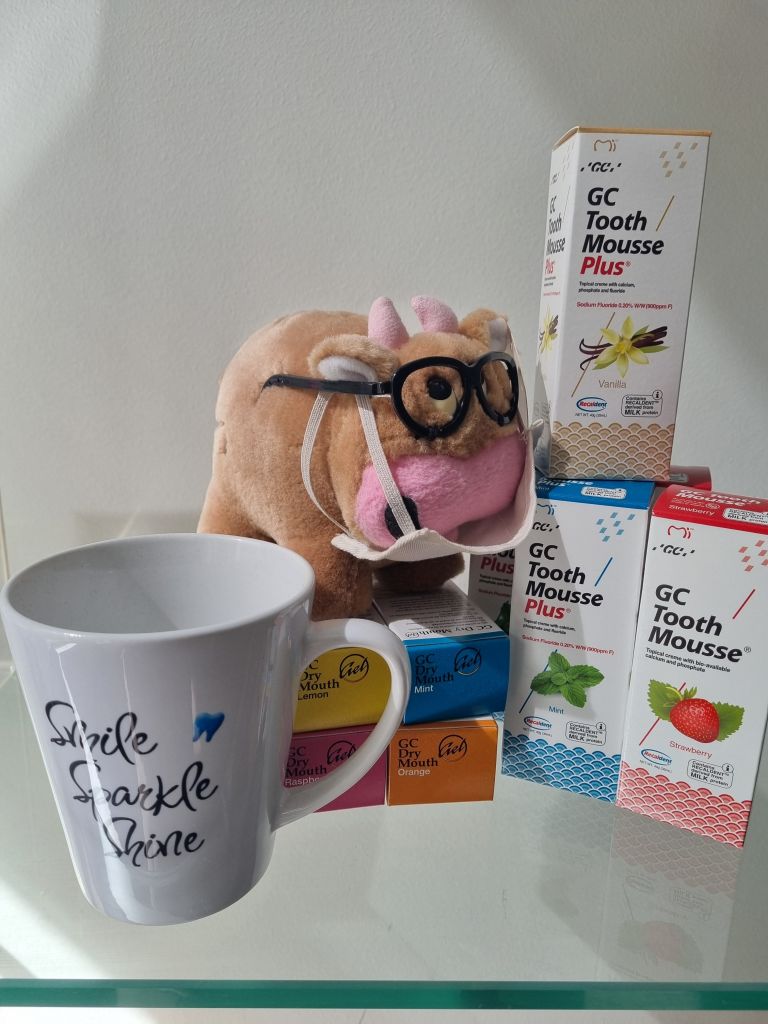
Teeth and alcohol do have some issues.  Most alcohols are acidic and the acid can remove the surface layers of enamel from teeth and can erode exposed root surface areas.   Recommendations for wine makers and professional wine tasters have been in use for almost a decade in relation to acidity and their teeth.  The recommendation is to use a remineralising creme regularly to prevent loss of tooth structure.  We have the GC products containing the peptide complex CPP-ACP (casein phosphopeptide amorphous calcium phosphate) at the clinic available for purchase to assist in remineralising teeth from acid erosion and to help prevent further erosion.  This product, called Tooth Mousse and Tooth Mousse Plus (added Fluoride) is derived from milk protein. They come in a variety of flavours.

Sugary drinks will always cause issues with teeth and once you add in the acid the issues are compounded. Soft drinks have a significant amount of sugar in them which sticks around the teeth creating an environment that the oral bad bacteria love.  The stickiness increases the depth of the plaque on the teeth changing the environment, so that the dynamic effect of the calcium and fluoride molecules going in and out of teeth to going more out and in.  Acids increase the process so more tooth structure demineralizes and doesn’t remineralise again.  When it doesn’t remineralise it creates a cavity that the oral bad bacteria can enter, the sugars feed them and they create further demineralization of the tooth and a bigger cavity.  The more frequent the sugar and acid are in the same place the more likelihood of a cavity occurring.  Dr Stone always tells the children that her most hated sugary thing is a lollipop, because they stay in the mouth for 45 mins bathing the teeth in sugar.

To help prevent this loss of tooth structure it is best not to keep sipping sugary, acidic drinks; use a straw so they don’t bath the teeth; use tooth mousse if required; see your dentist regularly for xrays of the areas between your teeth where the tooth structure is more vulnerable; make sure you floss and brush effectively especially prior to bed and no sugar and acid after brushing before bed.

See you in the clinic!  The Victoria Park Dental Care team.

PS:  check out our socials (Facebook, LinkedIn, Instagram) for top tips for teeth, mouth and gums and dental family snaps!  Maybe even the latest video on YouTube.